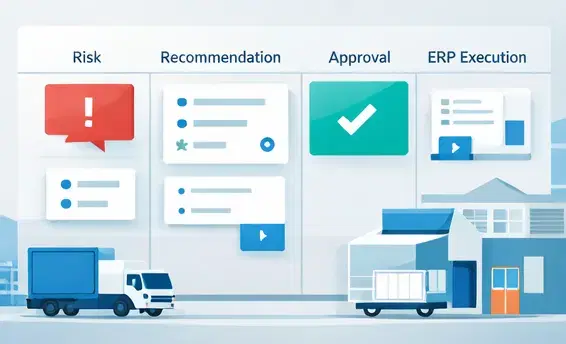

Stockout prevention depends on execution speed as much as planning quality. A slow replenishment workflow turns manageable risks into urgent shortages.
What a strong replenishment workflow looks like
A high-performing process should:
- Generate daily prioritized recommendations
- Distinguish critical from non-critical shortages
- Include supplier and network constraints
- Route decisions to the right owner quickly
- Sync approved actions into ERP without manual copy-paste
Recommended workflow design
1) Prioritize by business impact
Rank recommendations by service and revenue impact, not only by inventory gap size.
2) Separate decision types
Not every shortage needs a purchase order. Typical decision types include:
- Supplier order adjustment
- Internal stock transfer
- Delivery date escalation
- Demand-plan review trigger
3) Enforce clear approval lanes
Define who approves what, by threshold. This removes ambiguity and shortens cycle times.
4) Measure response quality, not only speed
Fast actions are useful only if they improve outcomes. Track service impact and follow-through.
KPI dashboard for workflow health
- Recommendation acceptance rate
- Time-to-decision for critical items
- Expedite order share
- Shortage recurrence rate
- Service-level recovery after alerts
Typical anti-patterns
- One giant backlog without priority
- Manual triage in spreadsheets
- Approval bottlenecks without thresholds
- No learning loop after incidents
Continue with the full cluster
- Stockout Prevention Playbook
- Supplier Collaboration Tactics to Reduce Stockout Risk
- Stockout Root Causes
Relevant modules: