
Why the next competitive frontier in supply chain management is not better forecasting but automated execution. With AI agents, the new numi MCP server and models like Claude and OpenAI.
Companies invest millions in AI-powered supply chain software. Forecasts become more precise, inventory models more sophisticated, recommendations ever more granular. And yet, at the end of the day, the planner opens their ERP, looks at the list of order proposals, and types them in by hand. In 2026, the real gap in supply chain management is not decision quality. It lies in execution.
This is exactly where agentic AI in the supply chain comes in. The BCG report "Supply Chain Planning 2026" confirms it too, after surveying more than 180 executives: the real bottleneck is not the technology, but how consistently companies connect decisions, processes and data into genuine execution. This article shows what agentic AI means, why supply chains are the ideal use case, and how to automate your supply chain with agents. And how the new numi MCP server connects models like Claude, Copilot and OpenAI directly to your supply chain processes.
Agentic AI in the Supply Chain: a Definition
Agentic AI describes AI systems that do not just make recommendations, but autonomously execute actions, orchestrate processes and act on external systems. The difference from classic predictive AI: a forecasting model predicts what will happen. An AI agent in the supply chain decides what to do, and does it. A recommendation becomes an executed order, an adjusted safety stock, a supplier request that has been sent.
Where an agent fits in can be read from Gartner's automation spectrum. It ranges from pure decision support to full autonomy:
- Decision Support: The human decides, the system provides transparency and diagnostics. A dashboard shows inventory risks; action is taken manually.
- Decision Augmentation: The system recommends options, the human confirms or adjusts. This is where most advanced supply chain solutions operate today.
- Decision Automation: The system decides and executes autonomously. Speed, scalability and consistency are the benefits and the core promise of agentic AI.
The decisive question is not whether a company pursues full automation, but which decisions are suited to which level and what the path there looks like.
Why the Supply Chain Is the Ideal Use Case for AI Agents
Supply chain decisions have a property that predestines them for automation: they are rarely subjective. A replenishment decision is based on forecasts, inventory, lead times, service-level targets and cost structures. It has to be numerically correct, consistent and reproducible. No gut feeling required.
Modern systems have long relied on proven algorithms for this: statistical forecasting methods, machine learning models like LightGBM or XGBoost, operations research optimization and rule-based decision logic. These models are precise and transparent, and they are waiting to be executed automatically. Agents do not replace this decision logic. They execute and orchestrate it.
Add to that the frequency: daily replenishment, weekly forecast updates, continuous exception management. The higher the frequency of a decision, the greater the leverage of automation. And the more expensive the manual break between recommendation and action.
Automate Your Supply Chain: Concrete Use Cases for Agents
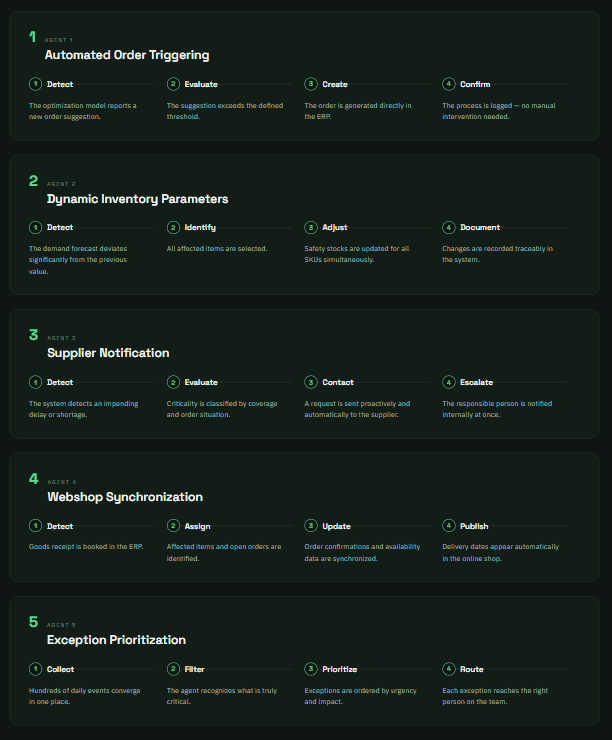
Automating your supply chain means, in practice: configurable workflows made of trigger, logic and action. Five example use cases that already run in production environments today:
- Automated order triggering: When an order proposal from the optimization model exceeds a threshold and stays within automation limits, the agent creates the order directly via APIs in the ERP, without manual input.
- Dynamic inventory parameters: When forecasted demand changes significantly, or supply risks are detected through lead-time predictions, the agent automatically adjusts safety stocks. For all affected SKUs simultaneously and consistently.
- Supplier notifications: When the system detects an impending delivery delay or potential shortage, the agent proactively sends a request to the supplier and escalates internally to the responsible planner or production scheduler.
- Event-based webshop synchronization: When a customer order is confirmed in the ERP, the agent updates order confirmations after an ATP check and pushes "available from" dates straight back into the online shop.
- Exception prioritization: From hundreds of daily events – such as out-of-stock situations, demand peaks, capacity spikes on individual production machines – the agent filters out the truly critical ones and routes them, prioritized, to the right persona on the team.
Workflows can be triggered on a schedule (daily, hourly) or based on events, depending on the process and the desired level of automation.
The numi MCP Server: Claude, OpenAI and Copilot for the Supply Chain
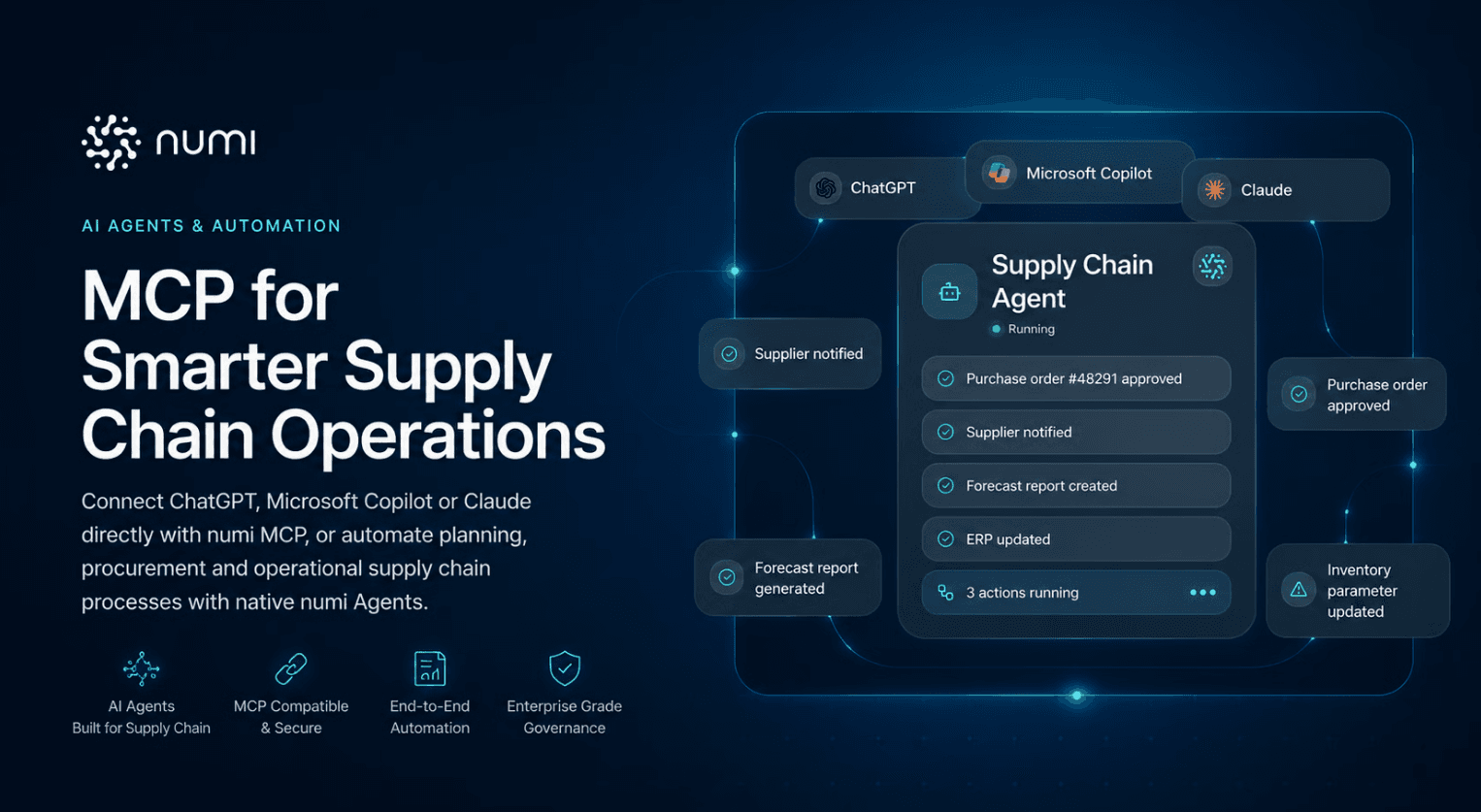
With the new numi MCP server, numi goes one step further. The Model Context Protocol (MCP) is an open standard that lets AI models communicate securely with external systems – a kind of universal interface between language model and software. The numi MCP server makes numi's supply chain intelligence accessible in exactly this way.
In concrete terms, this means two things:
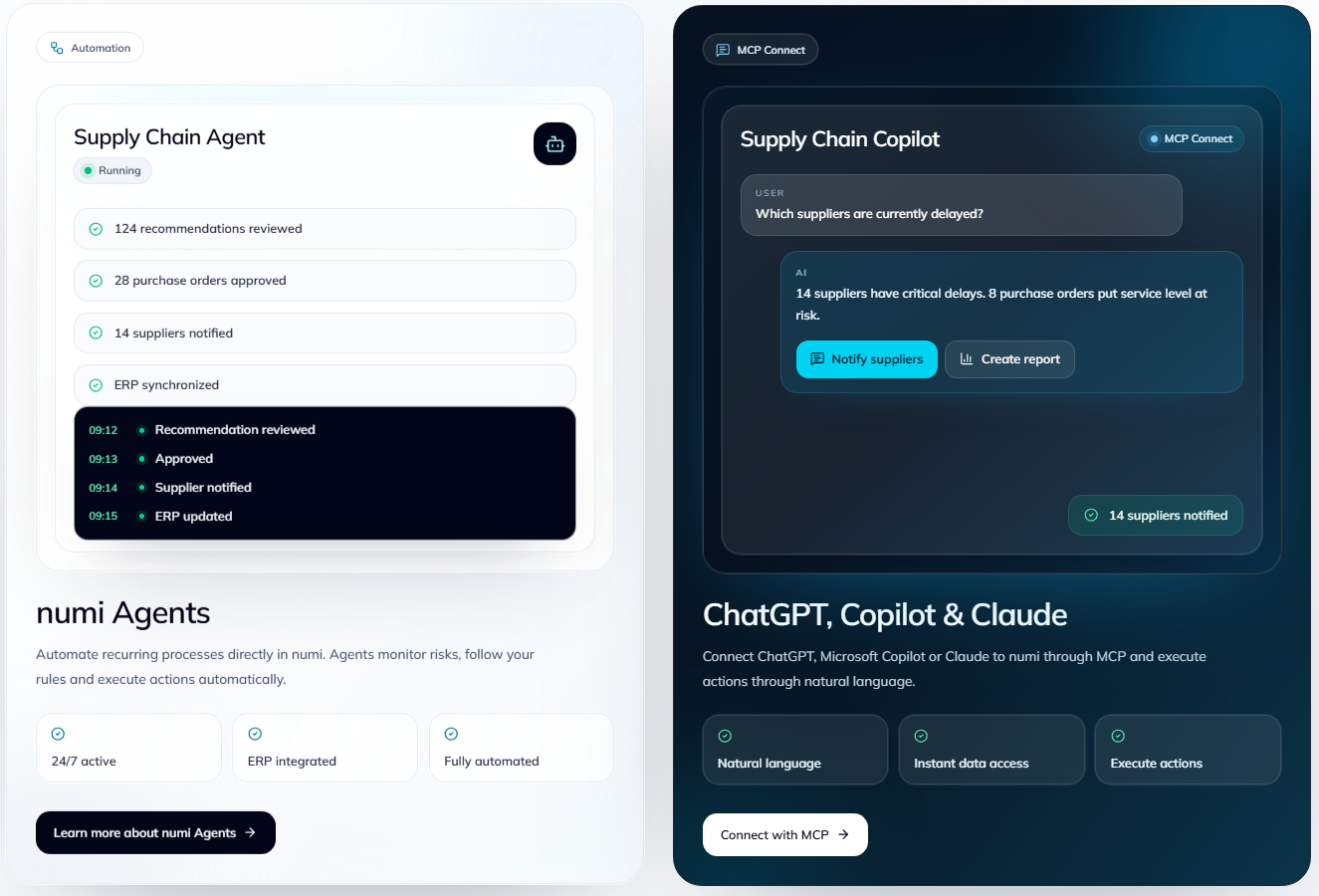
- Models like Claude and OpenAI access numi: Via the MCP server, external AI agents read structured numi data such as forecasts, inventory, lead times, order proposals and exceptions. A planner can query their supply chain in natural language, for example "Which SKUs are at risk this week due to delivery delays?", and receives a well-founded answer including a visualization based on the numi models.
- Agents execute numi tools and actions: The MCP server exposes numi functions as callable tools. With it, an agent can not only read but act: create an order, adjust a safety stock or start a workflow, within clearly defined permissions.
This lets numi embed seamlessly into existing AI environments, whether Claude, ChatGPT/OpenAI or an in-house copilot. numi's deterministic supply chain models deliver the correct decisions; the language model handles interaction, explanation and orchestration. Governance stays central: the company decides which data is readable and which actions are executable, through roles, rights and approvals.
Running Agents Directly in numi
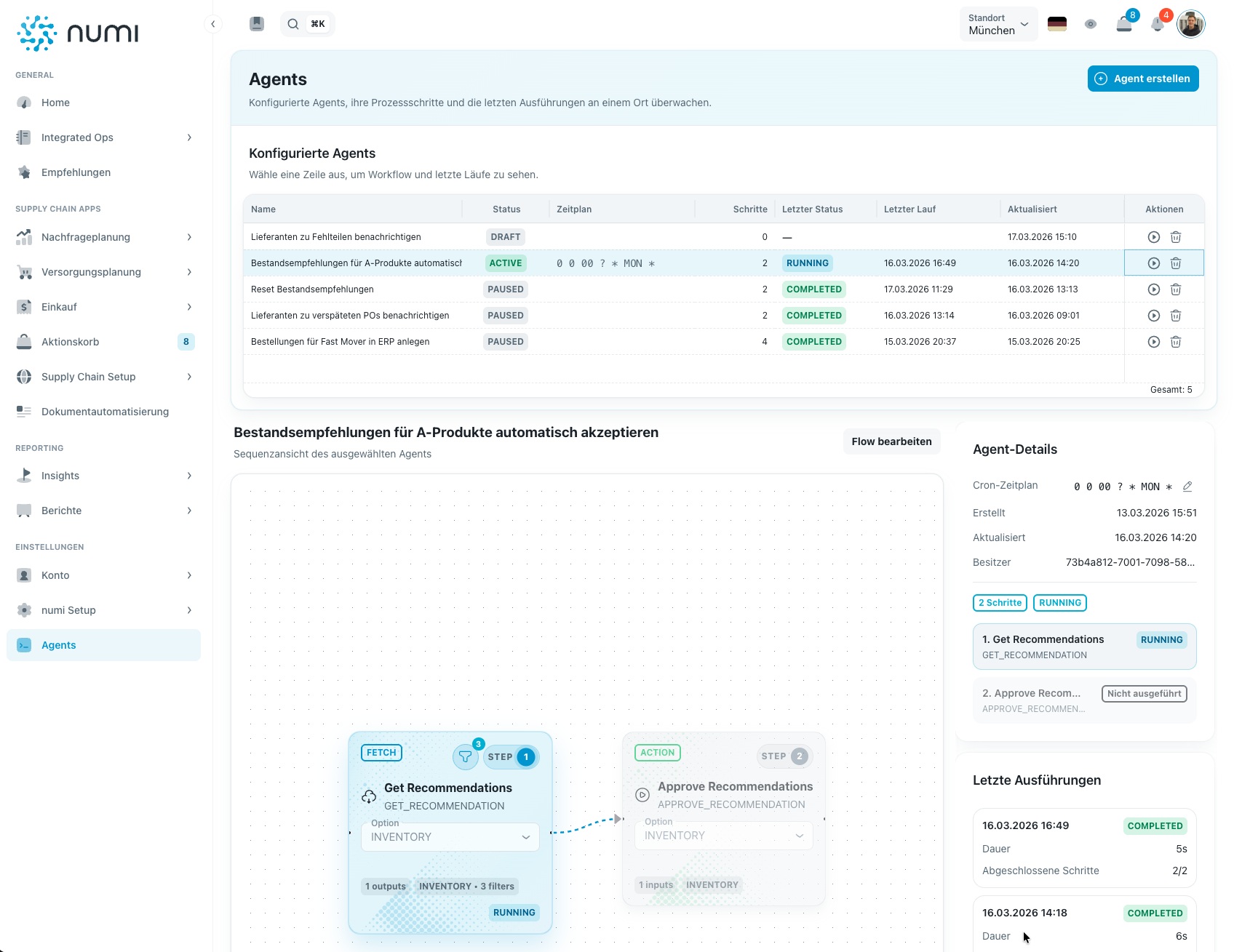
Not every company wants to run agents through an external model. That is why agents can also run directly in numi, as configurable workflows built on top of the proven algorithms. The architecture follows a clear pattern:
Trigger → Workflow logic → System integration → Execution
A typical setup consists of four steps:
- Define the trigger: for example, new order proposals or delayed deliveries.
- Configure the workflow: combine steps such as filters, approvals or actions.
- Connect the actions: for instance ERP updates or supplier notifications.
- Schedule execution: run agents on a schedule or triggered by events.
The company chooses the level of automation and expands it step by step as trust in the models grows:
- Fully automated execution: The agent acts without approval. Suited to high-frequency, data-driven processes with high trust in the models.
- Approval-based workflows: The agent proposes, a human approves. Ideal for critical or new use cases.
- Monitoring and alerts: The agent observes and informs, but does not act on its own. The first step toward building trust.
Guardrails Instead of Full Automation: Humans Set the Boundaries
Full autonomy is not the goal, and not what practice demands either. BCG also notes that fully autonomous planning remains an aspiration for now. The better approach: humans set the guardrails within which automation happens.
Within these guardrails, agents act independently and at high frequency. We mean defined thresholds, quantity, value and risk limits, as well as approved suppliers. Beyond the guardrails, the human takes over. If a transaction exceeds the defined limits, it is not executed automatically, but escalated as an exception to the right person.
Through continuous monitoring, the human stays informed at all times and can trace, adjust and, if needed, override every agent action. Experts provide the domain knowledge that algorithms alone do not have: company-specific constraints, seasonalities, supplier relationships. The machine takes over what it does better. The human leads where their judgment makes the difference.
Language models like Claude or OpenAI play to their strengths precisely here: processing unstructured data, generating explanations and supporting user interaction. For the core operational decisions, structured models and deterministic logic remain essential. The strongest systems combine both.
Conclusion: Execution Is the Next Competitive Frontier
The next competitive frontier in supply chain management is not "better forecasting". It is "better execution". Companies that put AI recommendations into action automatically – reliably, at scale and with full transparency – will outpace those that keep relying on manual processes.
numi has made this conviction the foundation of its architecture. Here, agentic AI is not a marketing promise but a concrete feature: configurable agents directly in numi, three levels of automation and the new MCP server that connects models like Claude and OpenAI to your supply chain. Understand data, generate high-quality decisions, execute them automatically and show humans only the exceptions that truly matter.
Frequently Asked Questions (FAQ)
What is agentic AI in the supply chain?
Agentic AI refers to AI agents that do not just recommend supply chain decisions but execute them autonomously, such as creating an order in the ERP or adjusting safety stocks. They do not replace proven forecasting and optimization models, but orchestrate and automate their execution.
What is an MCP server in the supply chain?
An MCP server (Model Context Protocol) is a standardized interface that lets AI models communicate securely with supply chain software. The numi MCP server exposes forecasts, inventory and actions as callable tools, so that AI agents can read numi data and execute actions.
Can Claude or OpenAI run a supply chain?
Via the numi MCP server, models like Claude and OpenAI can access numi, query data and trigger defined actions. The actual operational decisions are still made by numi's deterministic models. The language model handles interaction, explanation and orchestration, within clearly defined permissions.
How do I automate my supply chain with agents?
In numi, you configure agents as workflows made of trigger, logic and action. You choose the level of automation – from monitoring through approval-based workflows to fully automated execution – and expand it step by step as trust in the models grows.
See how numi automates your supply chain. Experience AI agents and the MCP server live in your own supply chain context.