
Black Friday and Christmas are approaching. Marketing and sales teams are planning campaigns, discounts and product selections. For procurement and supply chain teams, the critical work starts before the first promotional sale: the goods must be available on time. Campaigns also need a clear record so that their results can inform future demand planning.
Promotion planning connects the campaign period, the products involved and the expected additional demand with replenishment planning. It helps prevent stockouts during a promotion, limit excess inventory afterwards and interpret historical sales peaks correctly in the forecast. Intelligent forecasting models already recognize many seasonal patterns. A well-maintained promotion plan adds specific knowledge about the upcoming campaign.
Why successful promotions challenge demand planning
A campaign can generate more demand than existing inventory and confirmed deliveries can cover. If the additional demand is only considered shortly before the promotion starts, there may be no time left for a regular replenishment order. The remaining options may be expensive expedited shipping, a scaled-back campaign or lost sales.
Overestimating quantities also costs money. Goods left over after a promotion tie up working capital and may require further discounts. Focusing solely on availability overlooks this risk. Focusing solely on reducing inventory may put promotional sales at risk.
The interaction between events adds another challenge. A Black Friday promotion may bring forward purchases that would otherwise have happened in December. A Christmas campaign may coincide with demand that is already seasonally elevated. Promotions should therefore be considered alongside the weeks before and after them. More sales within a promotional window do not automatically mean more sales across the entire period.
Good planning connects three questions: What demand should we expect? When must the goods be available? And how will the campaign and product availability affect our later interpretation of sales figures? Our article on the planning errors behind stockouts explains other common reasons for missing inventory.
Work backwards from availability to the latest order date
The most important planning deadline is often the last point at which an order or production release can still affect availability. Work backwards from the required availability date and include the full time needed to make the goods ready for sale.
Latest order date = required availability date minus total replenishment lead time minus an additional risk buffer.
Depending on your process, replenishment lead time includes production, transport, customs clearance, goods receipt, inspection and distribution to sales locations. Do not subtract steps or buffers again if they are already included in the lead time. If the promotion starts on Friday but the goods must be ready in the fulfilment warehouse on the preceding Monday, that Monday is the relevant availability date.
A simplified example: the time from placing an order to receiving goods that are ready for sale is six weeks. Allow one additional week for uncertainty. The order must then be placed no later than seven weeks before the required availability date. Agreement on promotional demand needs to happen earlier still.
Check the deadlines for each product or supplier. A single deadline for the entire assortment hides important differences. With long lead times, the regular ordering window may already have closed even though Black Friday is still ahead. In that case, the most useful immediate measures are to confirm delivery dates, allocate available stock selectively and adjust the campaign scope or product selection. Only include an expedited delivery as available supply once there is a reliable commitment.
Also set a date for the next review. If the campaign scope, delivery commitment or expected additional demand changes, the affected replenishment decisions need to be clear. This gives replenishment planning an up-to-date demand plan in time to act.
Separate the baseline forecast from additional promotional demand
The baseline forecast is the existing sales forecast before any additional promotional uplift. It may already include Christmas demand, trends or promotional patterns learned from historical data. Planned additional demand must therefore be measured against what this forecast already expects.
Planned promotional sales = baseline forecast for the campaign period plus additional promotional demand.
The following is a simplified illustrative example for one product at one location. All figures cover the same promotional period. Available inventory has already been projected forward to the start of the campaign, with other committed demand deducted. The listed receipts are confirmed to arrive on time and have not been allocated elsewhere.
| Planning input | Quantity |
|---|---|
| Baseline forecast, including expected seasonality | 1,000 units |
| Additional promotional demand of 40 percent | 400 units |
| Planned sales during the promotion | 1,400 units |
| Target remaining inventory after the promotion | 200 units |
| Available inventory at the start of the promotion | 500 units |
| Further receipts available on time | 600 units |
| Remaining requirement to cover | 500 units |
The remaining requirement is therefore 1,400 + 200 − 500 − 600 = 500 units. Minimum order quantities, pack sizes and other constraints may subsequently change the actual order quantity. The remaining inventory of 200 units is an assumed target in this example, not a general safety stock recommendation.
Also check the timing of supply and demand. A receipt arriving after the sales peak cannot prevent a stockout before it arrives. Even when the total quantity is sufficient, supply must cover demand throughout the promotion.
A common mistake would be to add the entire sales target of 1,400 units to the existing forecast as additional demand. That would produce a planned requirement of 2,400 units. The correct uplift in this example is 400 units. Also check whether multiple campaigns affect the same product during the same period and whether their assumptions overlap.
Historical promotions give sales peaks the context they need
For future forecasts, it matters what caused a jump in sales. A recurring December increase, an exceptional discount campaign and a major new customer can produce similar curves in the short term. They have different implications for the next planning cycle.
If the effect of a one-off promotion is carried forward as permanently higher baseline demand without being assessed, the forecast may become systematically too high. Conversely, removing a recurring seasonal increase as an outlier can erase an important demand pattern. Christmas demand should remain part of the seasonal pattern; an additional Christmas campaign needs further context. Modelling temporary events is an established time series forecasting approach, as explained in Forecasting: Principles and Practice on interventions.
Record the campaign period, affected products and assumptions during planning. Afterwards, retain changes and information about the actual conditions as well. These might include an earlier start, an extended promotional window or periods of limited availability.
Stockouts are particularly important when interpreting the results. Sales show what was sold under the availability conditions at the time. If a product sold out, its history does not fully reflect potential demand. Lower sales do not necessarily indicate a weak campaign.
After the promotion, compare the plan, actual sales and an appropriate reference value. Also review demand in the following weeks. Comparisons with previous periods help put results into perspective, but an observed difference alone does not prove that the campaign caused all of the additional sales. Seasonality, price, assortment and availability may also play a role.
What intelligent forecasts recognize and what the promotion plan adds
Suitable forecasting models can learn recurring seasonal patterns and trends from historical data. Depending on the method, configuration and available data, unusual demand observations can also be identified and handled. Businesses therefore do not need to explain every fluctuation manually.
A promotion plan adds particular value when something is about to change: this year's campaign starts earlier, runs longer or features different products. These are specific business decisions that cannot be reliably inferred from sales history alone.
A well-maintained plan makes this information usable for demand planning. Both the expected additional demand and its timing matter. Forecasting methods can explicitly account for historical and future event periods; the Prophet documentation on holidays and special events provides an example.
Which historical campaign information feeds directly into a model depends on the forecasting method and its setup. In every case, a clear campaign history provides a better basis for assessing forecasts, explaining changes and improving assumptions for the next campaign.
How numi supports promotion planning
numi connects AI-powered demand forecasting with planning teams' knowledge of upcoming campaigns. The models can recognize recurring seasonality and trends, while automatic outlier handling functions complement forecasting depending on the setup.
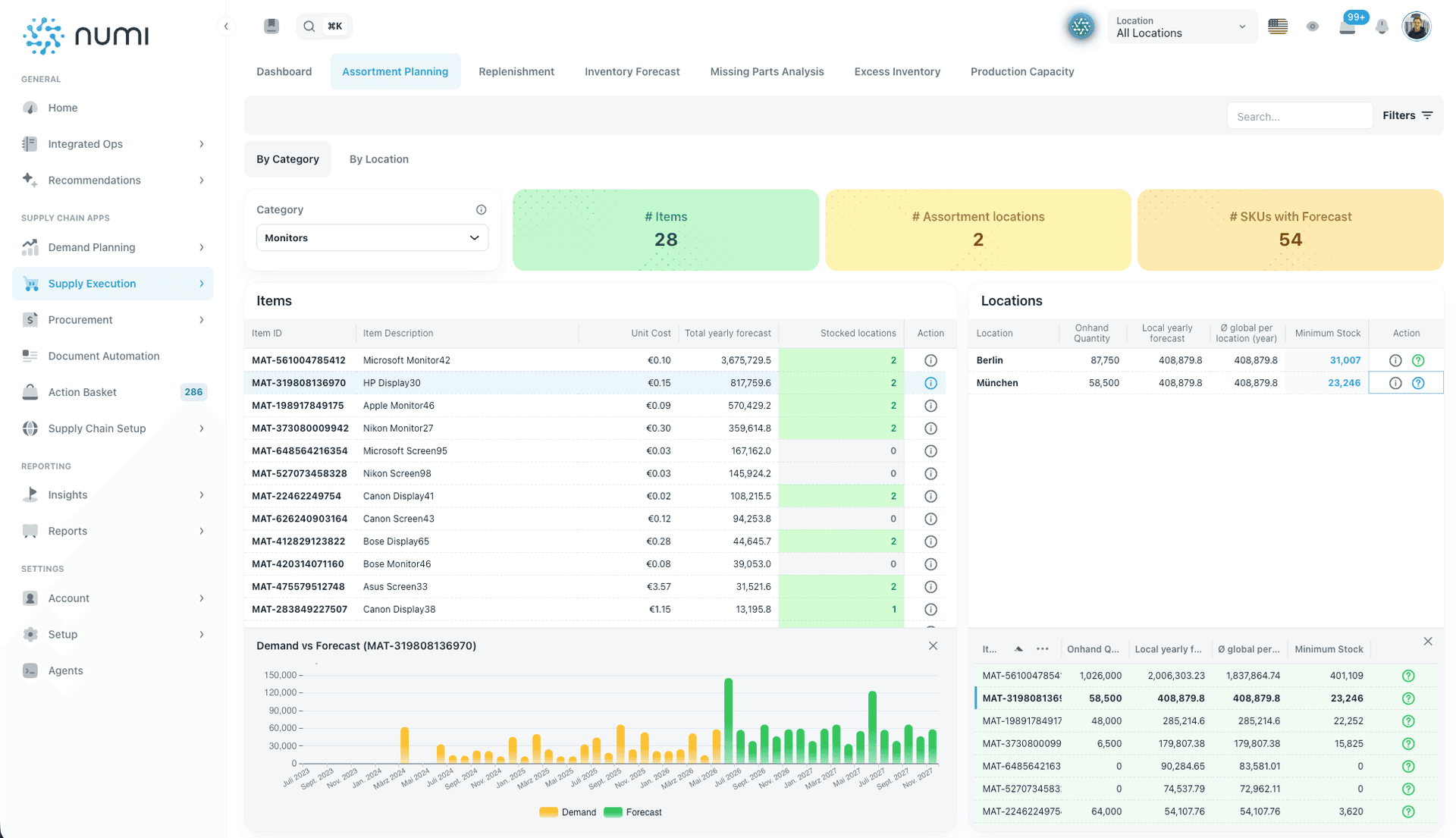
For a planned promotion, you define the campaign period and the affected products or planning units. You then enter the expected additional demand as a percentage uplift, total quantity, quantity per product or revenue value. This additional demand can be distributed according to the existing forecast or evenly across the promotional period.
Promotional demand is taken into account as a separate component of the final forecast. The entered dates determine how it is allocated across the affected planning months. For example, a promotion spanning two months can be planned according to the share of its duration in each month. Approved manual adjustments and the chosen forecasting configuration continue to govern the final result.
This provides an updated demand plan for coordinating inventory, incoming supply and replenishment. Planning and procurement teams assess which additional quantities need to be covered on time in the context of available inventory and delivery dates. Connecting this with inventory planning helps balance availability targets and working capital.
Once a recorded promotion has ended, you can compare planned quantities and calculated revenue values with actual sales developments at campaign and product level. The analysis helps you review your assumptions: Where was the expected additional demand realistic? Which products deviated from the plan? Which differences should be investigated before the next campaign?
Historical campaign knowledge, data-driven forecasting and operational assessment work together. Sales, marketing and supply chain teams can then work from a shared planning foundation.
Checklist for your next sales promotion
Review these points together before approving a campaign:
- Scope: Which products, locations and sales channels are included?
- Timing: When does it actually start and end, and when must the goods be ready for sale?
- Baseline forecast: Which seasonal effects and known patterns are already included?
- Additional demand: How much extra sales volume is expected, in which unit and based on what assumption?
- Supply coverage: Which inventory and confirmed receipts are available on time and free of other commitments?
- Lead time: What is the last practical date for ordering, production and internal distribution?
- Overlaps: Do other campaigns affect the same products or bring purchases forward?
- Ownership: Who updates changes, and when will the plan be reviewed again?
- Review: How will deviations from plan, stockouts and demand after the promotion be evaluated?
If time is limited, start with products whose expected promotional demand exceeds available supply and whose lead times limit your options. For these products, establish early whether additional supply can arrive in time or whether the campaign should be adjusted.
Frequently asked questions about promotion planning
When should Black Friday and Christmas be planned?
Before the relevant ordering or production deadlines are reached, at the latest. The deciding factors are the full replenishment lead time and the date from which goods must be available and ready for sale. A single number of weeks rarely makes sense across different assortments and suppliers.
Can AI recognize a promotion without a maintained campaign plan?
Models can recognize recurring patterns and unusual demand developments in historical data. That does not automatically reveal the specific scope of a new or changed campaign. A promotion plan adds knowledge about the products, timing and expected additional demand in particular.
Should promotions be removed from sales history?
Not as a blanket rule. Recurring seasonality should be preserved, while one-off promotional effects need to be interpreted appropriately. How a model handles this depends on the method and its configuration. Documented campaigns and information about stockouts help teams assess the history correctly.