
Which products belong in which store? How broad should the assortment be, how much stock should each item carry, and how do you plan new products that have no sales history of their own?
numi Assortment Planning connects these decisions in one end-to-end process. The platform creates robust demand forecasts for the entire network, breaks them down into store-level demand, and translates local forecasts into assortment breadth, inventory depth, and replenishment targets. Rules for displays, product groups, brands, and store formats become part of the same planning logic.
In short: What is assortment planning with numi?
Assortment planning with numi is the data-driven planning of items and inventory by location. It answers four connected questions:
- What is the expected total demand for an item?
- How is that demand distributed across stores or other locations?
- Which items should each location actually stock?
- What inventory depth and replenishment are required?
The key is that these levels are connected. Forecasting, assortment selection, and inventory planning use the same data and decision model. This keeps the plan consistent from the global network down to each item-location combination.
Why traditional store planning reaches its limits
Many retailers still plan assortments in spreadsheets or disconnected systems. Network-wide sales plans, local knowledge, space constraints, and inventory targets are combined manually. As the number of items and locations grows, familiar problems emerge:
- Local time series are too sparse for stable forecasts.
- Global demand is distributed to stores using blanket percentages.
- Assortment breadth and inventory depth are planned separately.
- Display and space constraints sit outside the forecasting logic.
- New products are planned using rough analogies or intuition.
- Rule changes are hard to explain and cumbersome to roll out.
- The plan does not automatically update inventory or replenishment decisions.
This creates a persistent trade-off: an assortment that is too narrow limits choice and availability, while an assortment that is too broad or deep ties up capital and increases excess-stock risk.
How numi approaches assortment planning
numi structures assortment planning as a repeatable process covering forecasting, disaggregation, selection, inventory calculation, and execution.
1. Build a common data foundation
Planning starts with the operational data already available, including:
- item and product master data,
- historical demand and sales,
- stores and location groups,
- on-hand and reserved inventory,
- purchase prices,
- open purchase and customer orders,
- lead times and order units,
- and product attributes such as brand, category, model, or display type.
numi connects this information across ERP, merchandise management, PIM, and other source systems. Product attributes are not merely filters; they can become planning dimensions and business rules in their own right.
2. Start with a robust global forecast
Individual stores sell many items only sporadically. Item-location time series therefore tend to contain few observations, many zero periods, and a high degree of random variation. A purely local forecasting model struggles to extract a stable signal from this data.
numi first pools demand at the global item level. The forecast uses the shared demand signal across the network without reducing the plan to a broad product-category estimate. Seasonal patterns, trends, and recurring demand become visible where sufficient data exists.
This global forecast is the consistent starting point for all downstream store planning.
3. Disaggregate the global forecast to each location
numi then breaks the global forecast down into individual stores. For established locations, it considers the share of historical item demand each store has generated.
New or data-sparse stores often lack enough history of their own. In these cases, numi uses a controlled fallback based on the demand shares of established locations. When multiple signals are available, they are combined; when they are missing, a clearly defined fallback logic applies.
Active item-location combinations can also be included even if they have not recorded sales yet. A store is therefore not excluded from planning simply because its history is incomplete.
The result is a forecast that is:
- aligned with the global item forecast,
- differentiated by local demand,
- robust for new locations,
- and operational at item-location level.
NPI forecasting: Planning new products without sales history
New Product Introductions are among the hardest problems in assortment planning. New collections, model generations, or technical variants have to be purchased and allocated before reliable sales data exists. This is common in the bicycle market, for example, where new model years and product variants are introduced regularly.
numi addresses this cold-start problem with learned launch curves. The platform analyses how established products developed during their first months on the market. Similar demand trajectories are clustered into representative launch profiles.
An initial forecast for a new product can then draw on several signals:
- the trajectory of comparable products,
- a selected like item,
- expected volumes for the first months,
- the planned launch date,
- relevant seasonality,
- and expert monthly adjustments.
As soon as initial demand arrives, numi can match the new product to the most suitable trajectory and update its forecast. With only a small number of observations, learned clusters stabilise the estimate instead of extrapolating a random early pattern unchecked.
For store allocation, numi combines an NPI's first demand signals with the general demand strength of each location. This gives stores without prior sales of the new item a sensible initial plan, while safeguards prevent unrealistic scaling.
Manage assortment breadth and display requirements through rules
A forecast describes expected demand, but it does not yet define what a physical assortment should look like. Brick-and-mortar retail also has to account for space, presentation, and range requirements.
numi groups products into flexible segments using criteria such as:
- display or fixture type,
- product group and category,
- brand or model family,
- item attributes,
- store group or location format,
- and freely combined rule groups.
The central guardrails of the assortment strategy can be defined for every segment:
- Minimum breadth: How many distinct items should a location carry at minimum?
- Maximum breadth: How many distinct items are useful or physically possible?
- Local forecast threshold: At what expected demand should an item be included normally?
- Minimum quantity: What base quantity should every selected item receive?
- Days of supply: How many days of demand should the planned inventory cover?
- Item exceptions: Which products need different minimum or maximum quantities?
This makes it possible to model very different strategies. A display-led segment may prioritise a broad choice with few units per item. Another category may benefit from a focused range with greater depth on the strongest products.
How numi selects items for each store
Selection follows a transparent sequence:
- numi ranks the items in a segment for each store using the local forecast.
- Items above the defined local forecast threshold are prioritised.
- An optional maximum breadth limits the number of selected items.
- If the minimum breadth has not been reached, numi first adds items with weaker local demand.
- If that is still insufficient, items with relevant global demand can complete the assortment.
- Items with no demand anywhere in the network are not selected merely to inflate assortment breadth.
This logic combines local relevance with network-wide knowledge. Locally strong products take priority, while globally successful products can support assortment breadth where local history is not yet meaningful.
From assortment selection to the right inventory depth
Once items have been selected, numi calculates how much inventory each item and location should carry. In simplified terms:
Minimum inventory = local daily forecast × target days of supply
If the result falls below the defined minimum quantity, that quantity becomes the lower bound. Individual items can have their own minimum and maximum overrides.
Two separate decisions are therefore connected without being conflated:
- Assortment breadth determines which items are carried.
- Inventory depth determines how many units of each selected item are needed.
Selected products can be planned as stocked items, while others remain purchase-to-order. The calculated parameters feed into inventory management and replenishment planning, where they are combined with current stock, open orders, lead times, order units, and further constraints to generate operational recommendations.
Hierarchy Lookup: From the entire network to a single item
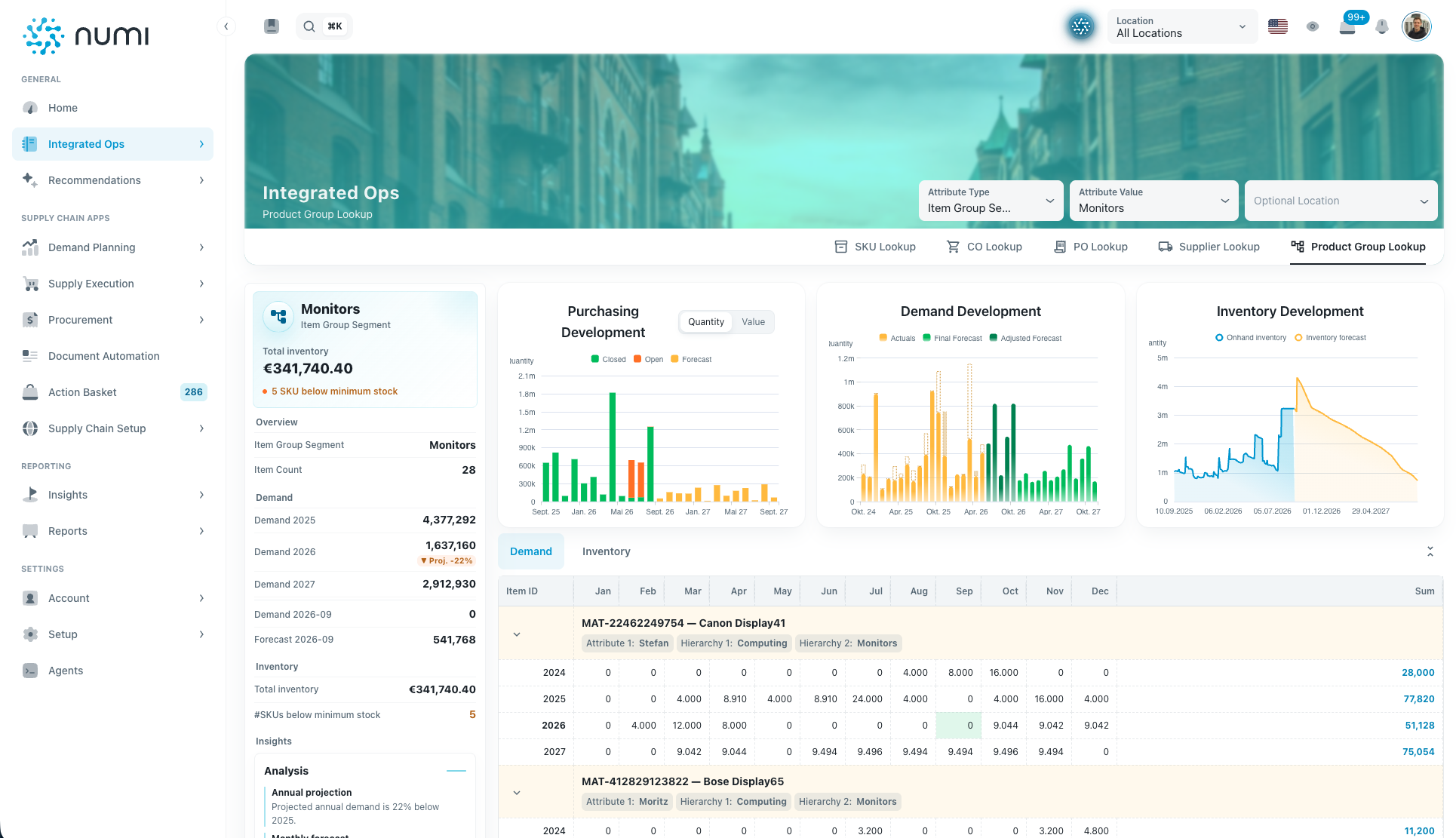
Assortment planning requires both local and aggregated views. numi's Hierarchy Lookup therefore makes demand, forecasts, purchasing, and inventory development visible across different product hierarchies.
Planners can select a brand or product group and analyse:
- historical demand and future forecasts,
- purchasing development,
- historical and projected inventory,
- inventory value and items below minimum stock,
- and the underlying items and monthly values.
The same analysis works globally across the network or with an optional location filter. A planner can move from an aggregated brand view to an individual store without manually reconciling separate reports.
Explainable decisions instead of a black box
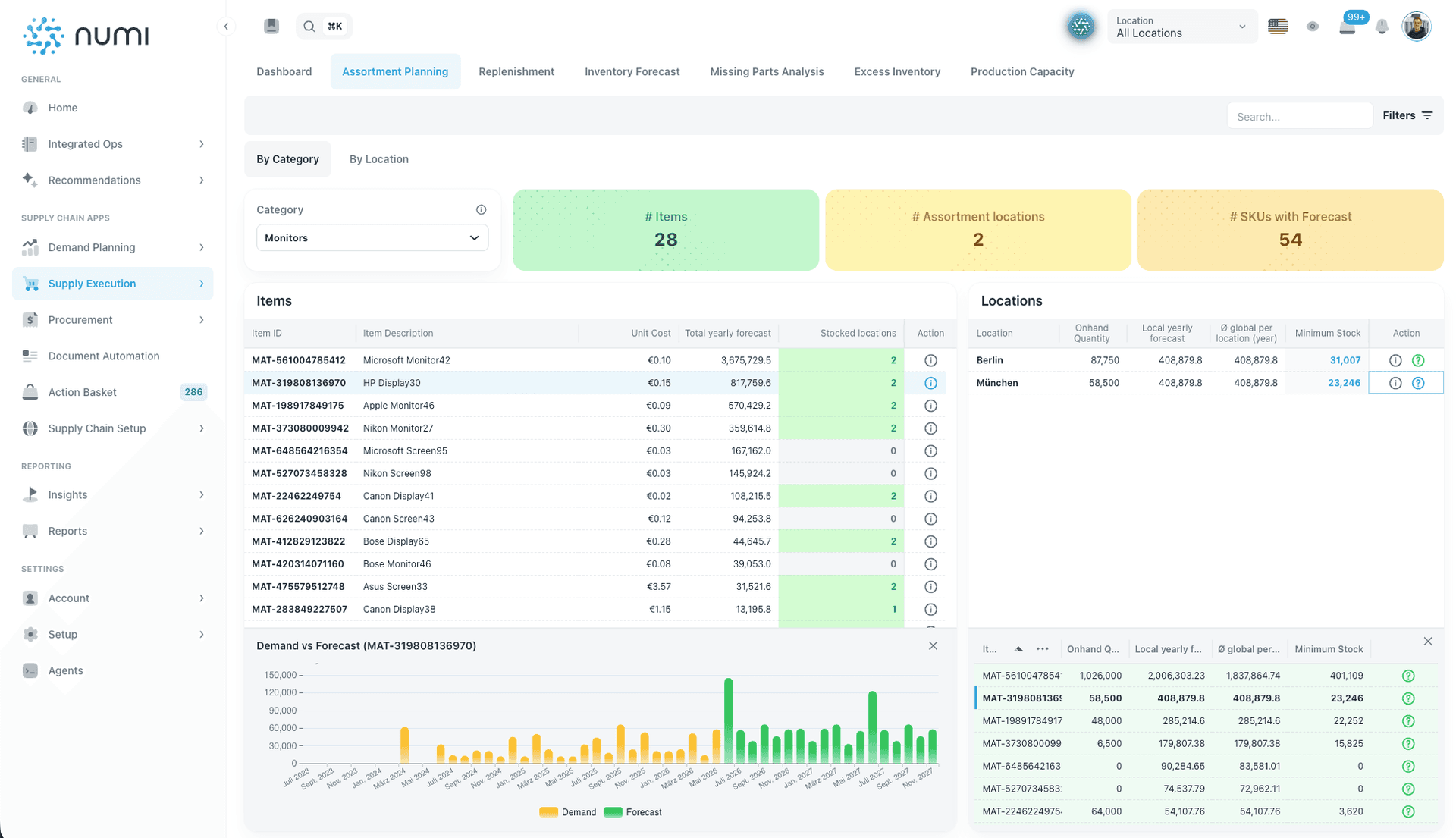
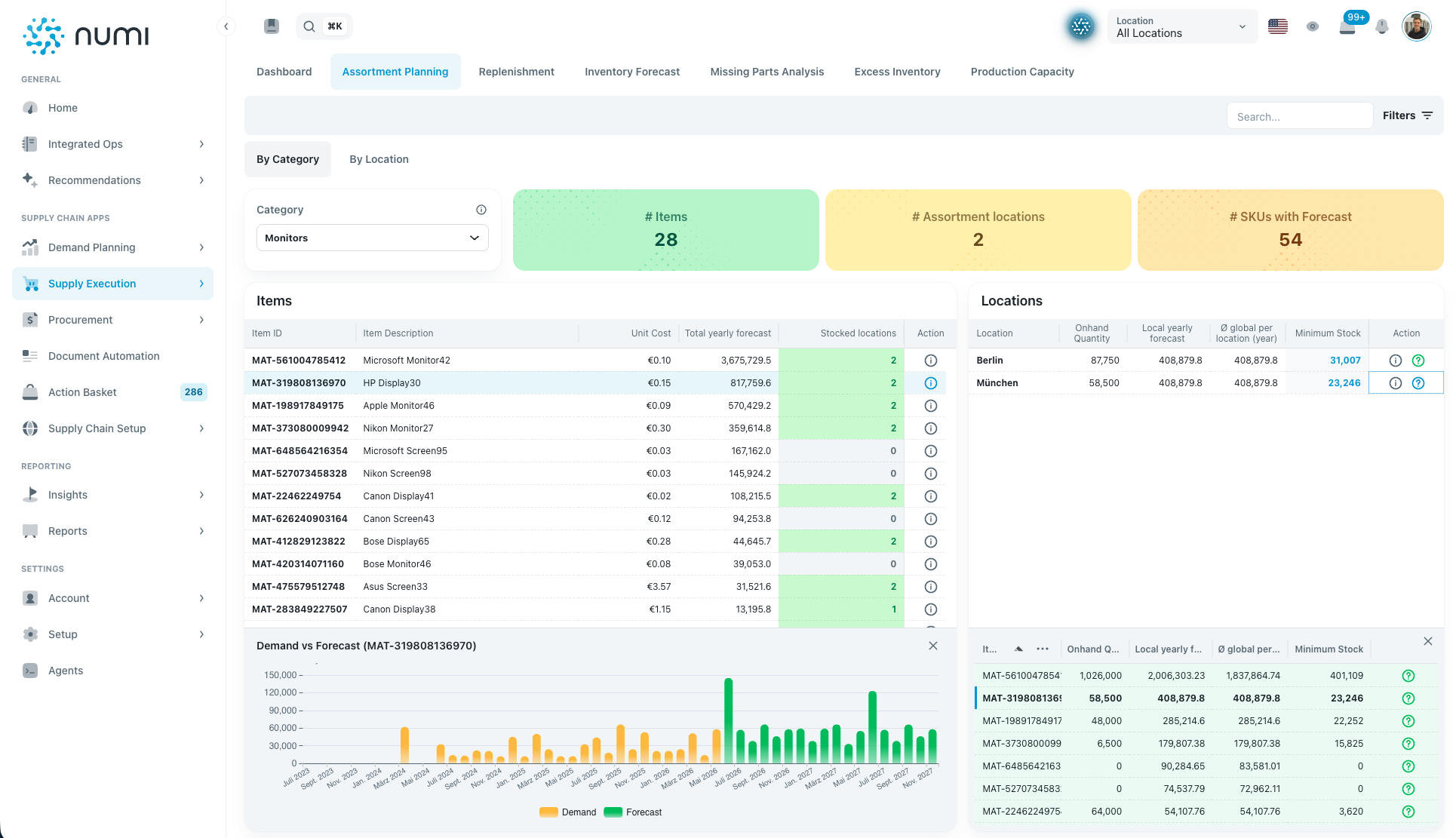
Planners need to know not only what the system recommends, but why. For each item and location, numi can show:
- the local annual forecast,
- the global forecast in the location comparison,
- on-hand and calculated minimum inventory,
- the number of stocked locations,
- the selection order,
- and the reason behind the assortment decision.
This makes it clear whether an item was selected because of local demand, added to satisfy minimum breadth, or excluded because maximum breadth had been reached. Forecast and actual demand can be compared over time, while expert adjustments remain controlled and visible.
One real-world example is Little John Bikes, where we use this approach to connect global forecasts, store-level demand, and assortment parameters in one planning process.
Why numi is a powerful assortment planning tool
numi's advantage does not come from one optimisation feature. It comes from connecting every decision in one continuous process:
| Planning question | How numi answers it |
|---|---|
| How much will the network sell? | A global item forecast using a more stable shared demand signal |
| How should demand be distributed across locations? | Data-driven disaggregation with fallbacks for new or data-sparse stores |
| How are new products planned? | NPI forecasting with launch curves, like items, seasonality, and early demand signals |
| Which items should a store carry? | Rule-based selection with minimum breadth, maximum breadth, and forecast thresholds |
| How much inventory does a selected item need? | Local forecast, days of supply, minimum quantity, and item-specific limits |
| Why was a decision made? | Explainable selection reasons, rankings, and forecast histories |
| How does the plan become an operational action? | Direct connection to inventory parameters, replenishment recommendations, and ERP processes |
The result is a closed-loop process: forecast globally, allocate locally, apply assortment rules, calculate inventory, explain decisions, and execute operationally.
Frequently asked questions about assortment planning
What is assortment planning?
Assortment planning determines which items should be offered or stocked at which locations. It combines expected demand, assortment strategy, available space, inventory, and commercial goals into a specific item-location allocation.
What is the difference between assortment breadth and inventory depth?
Assortment breadth describes how many distinct items are carried. Inventory depth describes how many units of each selected item should be available. numi plans both together so that a broad choice does not automatically create excessive inventory.
How does numi distribute a global forecast across stores?
numi uses the historical distribution of demand as a local allocation key. For new or data-sparse locations, a defined fallback logic draws on established stores. This keeps store planning aligned with the global forecast while making it locally actionable.
How does numi plan products without sales history?
numi uses representative launch trajectories from comparable products, like items, expected initial volumes, launch timing, and seasonality. As the first actual sales arrive, the forecast is updated using the most suitable demand profile.
Can display requirements be included in assortment planning?
Yes. Items can be segmented by display type or any other product attribute. Each segment can have its own assortment breadth, forecast threshold, days-of-supply, and minimum-quantity rules.
Can different store formats be planned differently?
Yes. Locations can be planned individually or as groups. This supports different assortment breadth and inventory coverage for large stores, smaller locations, or specialised store concepts.
Are numi's recommendations explainable?
Yes. numi shows local and global forecasts, inventory values, selection rankings, and selection reasons. Planners can understand why an item is or is not carried and intervene in a controlled way when necessary.
Conclusion: Assortment planning as an end-to-end decision process
Effective assortment planning does not end with a list of products per store. It starts with a reliable forecast, accounts for local demand and strategic assortment rules, and translates the result into inventory and replenishment.
numi connects these steps in one platform. Global forecasts create a stable demand signal. Disaggregation makes it actionable at store level. NPI forecasting closes the data gap for new products. Rule-based assortment planning controls breadth, displays, and inventory depth. Hierarchy Lookup keeps performance transparent from the entire network down to the individual location.
Learn more about numi forecasting, AI-powered inventory management, and automated replenishment planning. Or book an intro call with our team.