
A delivery is running late. Which customer commitment does that put at risk?
Procurement needs a revised date from the supplier. Inventory planners need to know how long stock will last. Sales and production planning need a reliable answer about which orders can still be completed on time. When that information sits in separate systems and inboxes, every delay triggers another search for answers.
Delivery date monitoring means comparing committed delivery dates with current supplier and shipment information to detect deviations early. To assess the impact of a delivery delay, companies need to connect delivery dates with inventory and specific demand. Only then does a status update become a basis for decisions: which purchase order line is critical, which order is affected, and who needs to act?
numi connects supplier coordination, shipment tracking and shortage analysis to support this process. This article explains how these capabilities create an operational workflow based on the principles of a supply chain control tower, and where companies can reduce manual work.
When does a delivery delay put your orders at risk?
A late delivery becomes critical when available inventory and other usable receipts cannot cover demand before it arrives. The number of days a delivery is late tells you little on its own.
A simplified hypothetical example: A distributor has 100 usable units of stock available for its committed customer orders. These orders require 20 units per day. A replenishment delivery was due to be available from day five but will now be available from day nine. Existing stock covers the orders for the first five days. Days six to eight leave a total shortfall of 60 units. In this example, a four-day delivery delay creates a three-day supply gap.
The calculation assumes steady demand and no other receipts. In practice, individual demand dates, reservations and other receipts must be considered. For another item, even a longer delay may be manageable if sufficient stock is available.
In retail and distribution, the gap affects customer orders, advertised availability or planned promotions. In manufacturing, a missing component can delay an assembly and, in turn, several production and customer orders. The priority is to identify these dependencies in time.
How does delivery date monitoring help with delivery delays?
Early warning requires a way to trace changes in delivery dates through the supply chain. This involves four steps:
- Detect the deviation: Compare the supplier confirmation or expected arrival with the previously committed date.
- Check supply coverage: Bring together available inventory, reservations, other receipts and demand by date.
- Identify affected orders: Determine which customer orders are affected and trace dependencies through assemblies and production orders.
- Coordinate the response: Inform the responsible people and review options such as expediting, partial delivery or planning changes.
A current position on a transport map tells you where a shipment is. Procurement and inventory planning also need to know: Will the material be available in time for the order that needs it? This connection makes delivery visibility useful in day-to-day work.
How does a supply chain control tower help with delivery delays?
A supply chain control tower brings together supply chain data and events so companies can identify critical deviations, set priorities and coordinate their response. For delivery delays, it connects supplier information, transport status, purchase orders, inventory and order demand.
Its operational value can be expressed through three questions:
- What has changed? A supplier confirms a later date, or a shipment's expected arrival moves back.
- What does that mean for us? Stock no longer covers demand until the receipt; specific customer or production orders are at risk.
- What do we do next? Procurement clarifies delivery options, inventory planners assess supply coverage, and the affected teams adjust their commitments or plans.
numi connects core capabilities within this workflow: coordinating delivery dates and quantities with suppliers, tracking shipment deviations, assessing order risks and triggering internal notifications.
How numi connects delivery dates, order risks and action
For procurement, inventory planning and production planning, the connection matters: a recommendation to expedite should relate to a specific requirement. A delay alert should show which orders are affected. numi supports this process before and after dispatch.
Before dispatch: align supplier deliveries with demand
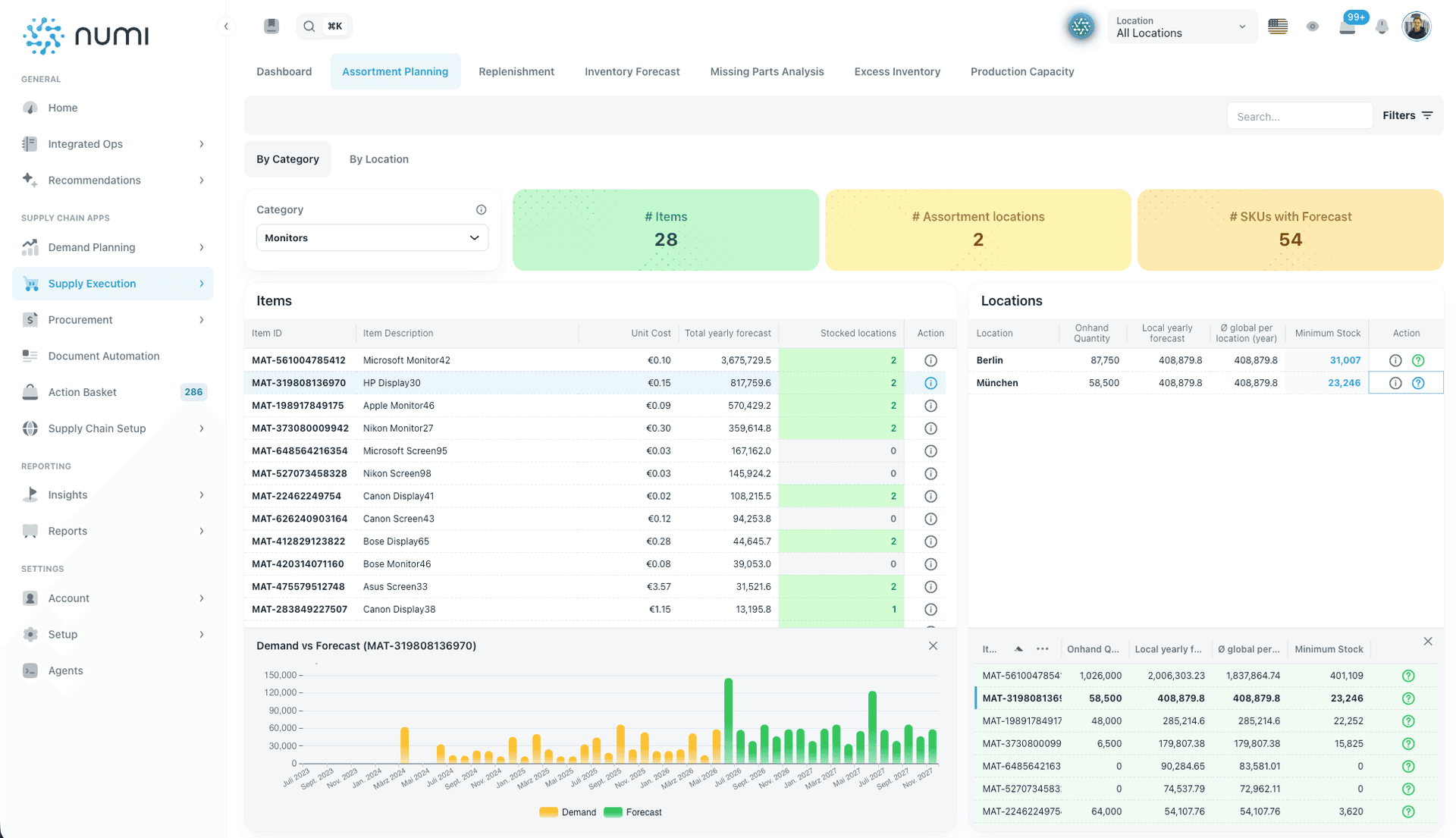
When demand changes, the original delivery date may no longer fit. numi calculates which purchase orders should be expedited, postponed or cancelled. Buyers receive specific recommendations for supplier discussions: which order line is needed earlier, which quantity can arrive later, and which receipt is no longer required?
Through the numi Supplier Portal, buyers and suppliers coordinate delivery dates and quantities. Questions, confirmations and escalations remain linked to the relevant purchase order. Teams can see which commitment applies and where clarification is still needed.

After dispatch: track expected arrival and delivery delays
For connected shipments, numi tracks the estimated time of arrival (ETA) and automatically flags delays. Teams can review deviations directly on the affected purchase order lines. For the ocean shipments shown here, an interactive map adds the route and vessel position to the shipment timeline.
Two dates need to be distinguished. Expected arrival at the discharge port is a transport milestone. For customer orders and production, what matters is when the goods will actually be available at the required location. Depending on the process, unloading, customs clearance, onward transport and goods receipt may still lie between these dates. The port ETA therefore needs to be checked before it is used as the date when stock becomes available.

An expedite recommendation and shipment ETA on the purchase order line: changes against the promised date are highlighted in colour.
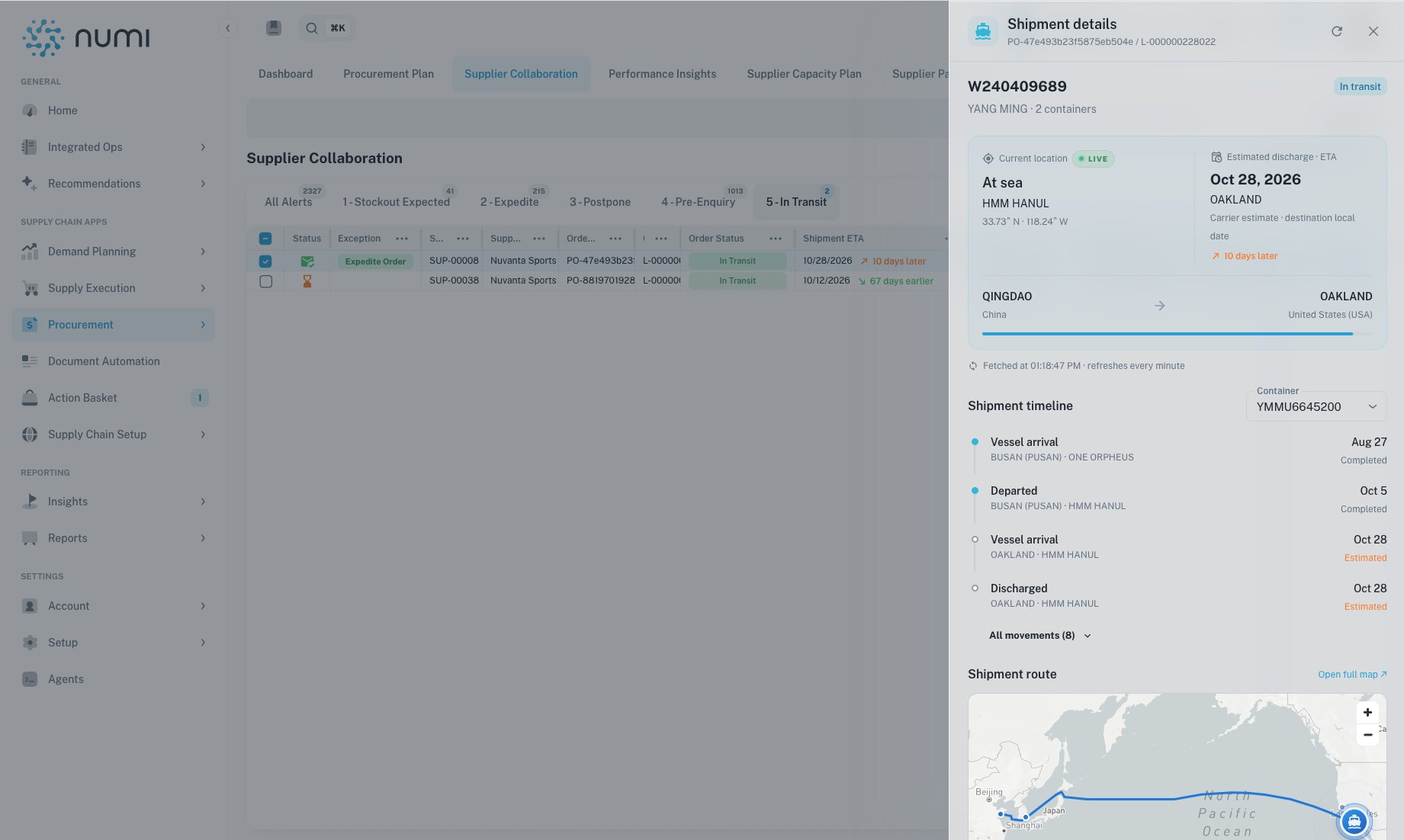
Shipment details bring together expected arrival, delays and transport milestones. The map also shows the route and vessel position. Click to open the complete view.
Assess the impact on customer and production orders
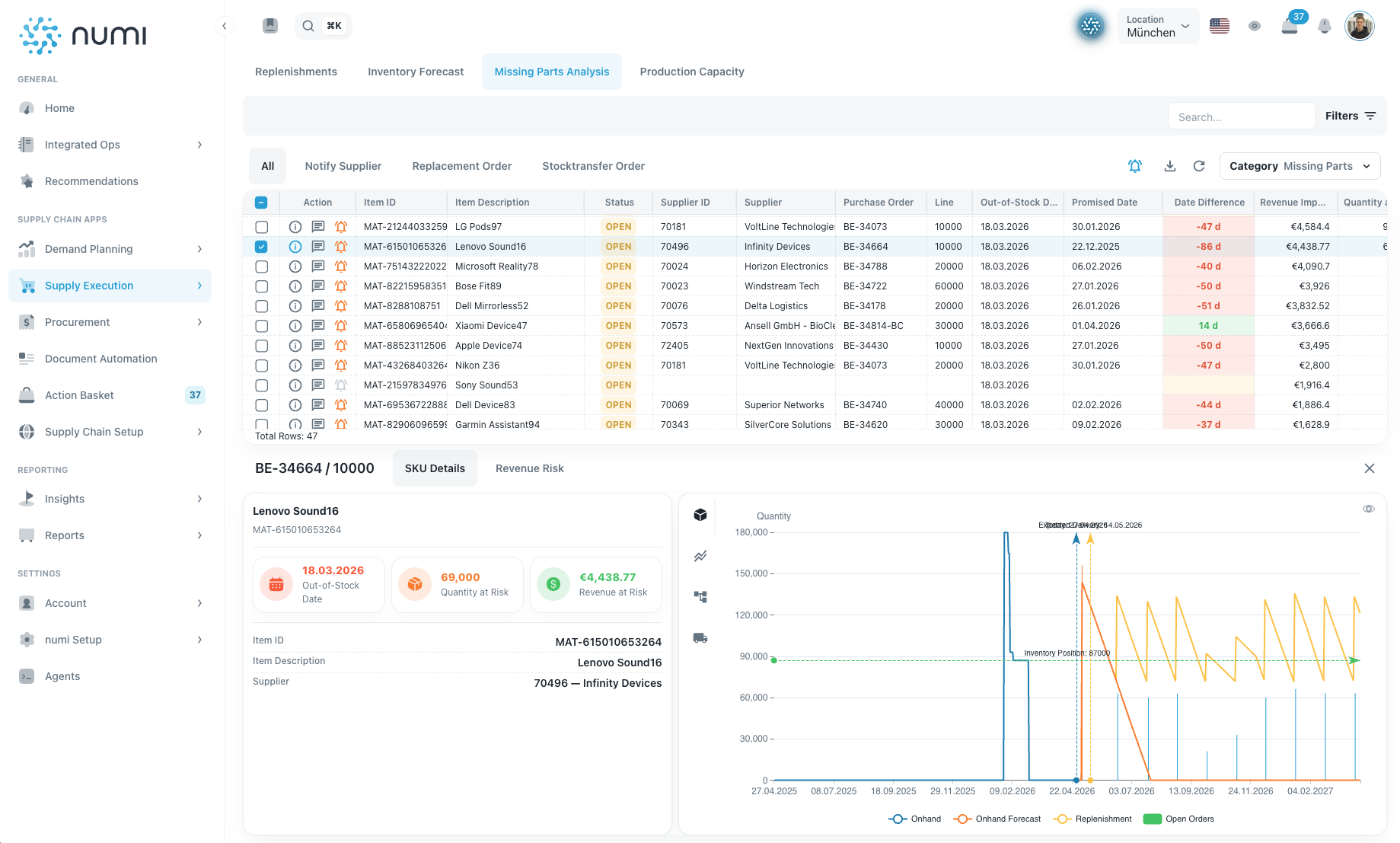
A delay on a purchase order line is easier to assess when its consequences are visible. numi shortage analysis connects inventory, demand and multi-level bills of materials. This helps teams understand which materials are missing, which assemblies are affected, and which production or customer orders are under pressure.
The responsible people can be informed through notifications and defined escalations. Procurement, inventory planning, sales and production planning gain a shared reference point: the specific shortage and its consequences.
This supports meaningful prioritisation. The purchase order with the most days of delay does not necessarily need attention first. A smaller deviation may be more urgent if it blocks a component needed immediately.
Who needs to act when a delivery delay becomes critical?
An alert saves time when it is clear who makes the next decision. Each team needs a specific role in a coordinated process:
- Procurement: Establish a reliable delivery date and agree on expediting, partial delivery, postponement or cancellation with the supplier.
- Inventory planning: Review stock coverage and alternative receipts, and allocate available quantities to demand.
- Production planning: Assess affected assemblies and production orders, and coordinate possible scheduling changes.
- Sales and customer service: Review commitments at risk and use shared, agreed information to notify customers of changes.
numi supports information gathering, assessment and distribution. Responsibility for delivery commitments, priorities and actions remains within the company's agreed process. This helps the team focus on critical exceptions instead of tracking every purchase order individually.
Which KPIs measure the value?
Both delivery performance and the effort required to manage exceptions show whether the process is improving:
- Customer on-time delivery (OTD) and on-time in-full delivery (OTIF): Are customer orders fulfilled by the promised date and in the agreed quantity?
- Material shortages and stockouts: How often are goods or components unavailable, and for how long? What production delays result?
- Supplier on-time delivery: What share of deliveries arrives on the agreed date?
- Inventory value and working capital: Can unnecessary receipts be limited while protecting critical demand?
- Detection and response time: How much time passes between information about a deviation becoming available and the first action?
- Manual effort: How much processing time do status checks, impact assessment and internal coordination require per purchase order or exception?
A reliable comparison needs consistent reporting periods, quantity measures and date baselines. Moving a promised customer date after a delay should not make an originally late delivery appear on time. The scale of improvement depends on data quality, the starting point and the actions actually taken.
Frequently asked questions about delivery delays and delivery visibility
What is the difference between an ETA and a confirmed delivery date?
The ETA is the current expected arrival at a defined location, such as the discharge port. The confirmed delivery date is the commitment to deliver at the agreed handover location. These dates can refer to different places and process steps. Supply planning needs to translate them into the expected point when the goods will be available for use.
What data is needed for delivery date monitoring?
The process needs purchase order lines with quantities and dates, current supplier or shipment information, available inventory and demand by date. Production orders and bills of materials are also needed for manufacturing. The more current and clearly linked this information is, the more reliably the impact of a delivery delay on affected orders can be assessed.
Can software prevent delivery delays?
Software cannot reliably prevent a delayed shipment or a supplier disruption. It can make deviations visible earlier, assess their impact on orders and speed up coordination. The benefit lies in gaining more room to act, for example by arranging a partial delivery or informing affected customers earlier.
Which companies benefit most from numi when managing delivery delays?
numi is particularly relevant for retailers, distributors and manufacturers with many open purchase orders, changing demand or dependencies between materials, production orders and customer orders. Connecting the Supplier Portal, shipment information and shortage analysis helps where manual lists and individual status checks no longer provide a reliable way to set priorities.
Manage delivery delays with numi
If procurement researches delivery dates, inventory planners separately check stock, and sales then asks which orders are affected, much of the effort sits between those steps. numi brings the information together and supports the workflow from supplier coordination to the internal response to a shortage.
Discuss your specific process with us: Which purchase orders are critical, what data is available, and how do alerts reach the responsible people? Together, we can assess how numi can help protect your delivery performance and reduce recurring manual work.